Pros and Cons of Radiant Cooling in Humid Climates

SECTION 01 // BUILDING PHYSICS & CLIMATE IMPACT
1. THE SUBTROPICAL COOLING DILEMMA
In East and Southeast Asia, the commercial building sector accounts for over 30% of total primary electricity consumption. Within modern commercial office towers in Hong Kong, Singapore, and Bangkok, between 41% and 51% of total operational power is consumed exclusively by HVAC chillers, air-handling units, and mechanical ventilation.
Subtropical and tropical hubs face high ambient temperatures coupled with persistent relative humidity exceeding 80% RH. Conventional all-air Variable Air Volume (VAV) and Fan Coil Unit (FCU) systems attempt to solve both sensible cooling and moisture removal using massive air volumes chilled to low temperatures, creating intense energy penalties, acoustic fan rumble, and high-velocity drafts.
To meet aggressive decarbonization standards under BEAM Plus, LEED Platinum, and Singapore Green Mark, forward-thinking developers and MEP consulting engineers are actively specifying hydronic radiant cooling systems.
SECTION 02 // THERMODYNAMICS & SPATIAL EFFICIENCY
2. THE ENGINEERING ADVANTAGES OF HYDRONICS
2.1 Significant Architectural Freedom & Spatial Optimization
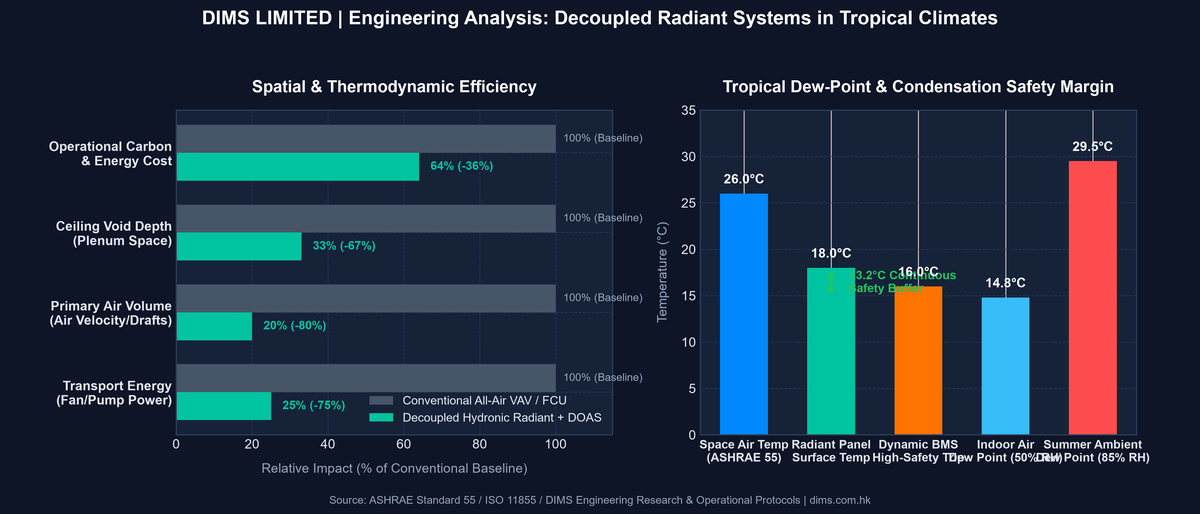
Water has approximately 3,500 times the volumetric heat capacity of air. Consequently, circulating water transfers thermal energy up to seven times more effectively than forced air. Handling space sensible cooling through water allows required air duct volumes to be reduced by up to 80%.
Plenum Height Reduction: Minimizing ceiling ductwork allows developers to compress ceiling voids from 600–900 mm down to 200–300 mm.
Structural Volume Savings: In commercial towers, saving 250 mm per floor equates to adding an entire additional leasable floor within the exact same municipal height zoning envelope.
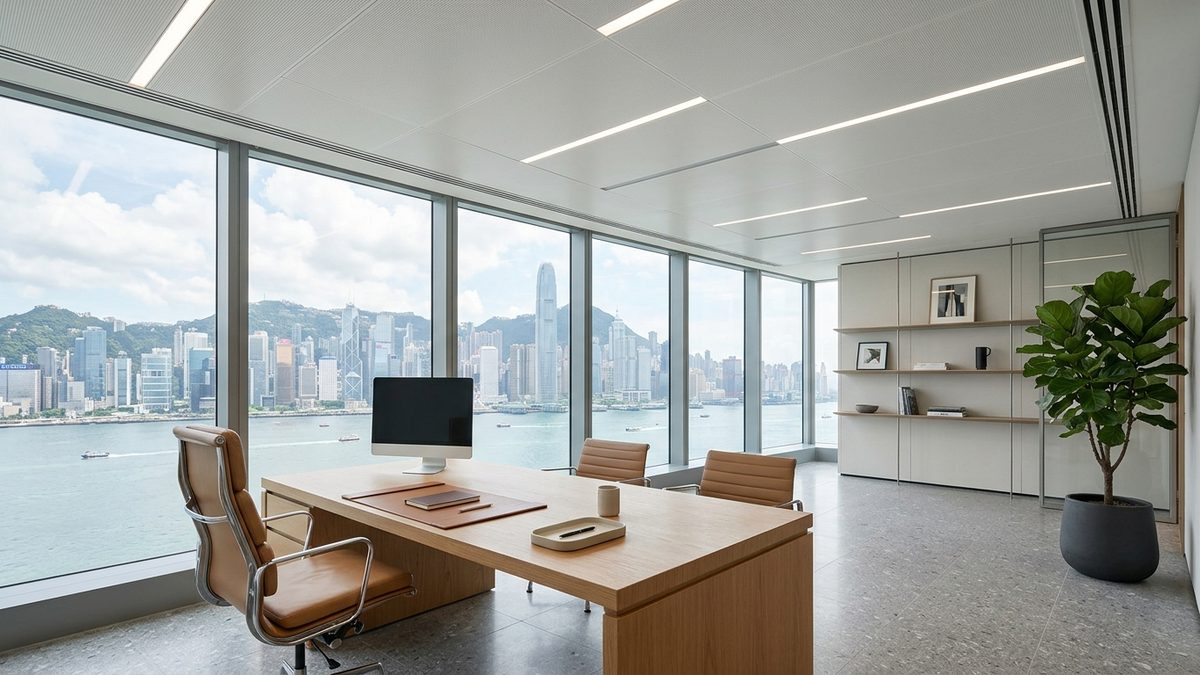
Daylight Penetration: With bulky ductwork eliminated, architects can specify true floor-to-ceiling perimeter glazing.
2.2 Superior Operative Comfort (ASHRAE 55 & ISO 7730)
Human thermal comfort is governed by Operative Temperature (To), which is a weighted balance of indoor air temperature and Mean Radiant Temperature (MRT). Forced-air systems blow chilled drafts (0.25–0.50 m/s) directly across occupants, triggering draft complaints and neck stiffness.
Radiant ceiling panels continuously absorb radiant heat directly from occupants and equipment without drafts (<0.10 m/s air velocity). Occupants experience identical or superior thermal comfort at higher indoor air temperatures (e.g., 25.5°C feels like 23.5°C), generating substantial compressor energy savings.
SECTION 03 // CONDENSATION RISK & DECOUPLED DOAS CONTROLS
3. DEBUNKING THE CONDENSATION RISK IN HUMID CLIMATES
3.1 Sensible and Latent Load Decoupling
The historic hesitation surrounding radiant cooling in tropical climates stems from the fear of surface condensation. If a chilled panel drops below the space dew point, moisture forms.
The definitive engineering solution is strict Sensible/Latent Load Decoupling. Radiant surfaces are never tasked with moisture extraction. DIMS Limited engineers hybrid systems where a Dedicated Outdoor Air System (DOAS) handles 100% of latent dehumidification and fresh outdoor air requirements.
By maintaining space relative humidity between 50% and 55% (dew point 14.0°C–14.8°C), chilled radiant panels operating at 17.5°C–19.0°C maintain a continuous +2.5 K to +3.5 K safety buffer above the condensation threshold.
[EN 1264 / ASHRAE 55 COMPLIANCE: VERIFIED] — Dedicated Outdoor Air Systems (DOAS) dehumidify all fresh air intake, locking space dew points at ~14.8°C. Chilled radiant surfaces operate at 18.0°C, providing a guaranteed continuous safety margin of ΔT ≥ +3.2 K with zero condensation risk.
3.2 Dynamic BMS Interlocks & Rapid Recovery
DIMS designs 3-stage condensation interlocks directly into the Building Management System (BMS):
Stage 1 (Normal Operation): Continuous psychrometric monitoring of space temperature, surface temperature, and dew point.
Stage 2 (Proximity Warning at ΔT < 2.0 K): Modulating 3-way injection valves raise supply water temperature automatically.
Stage 3 (High-Safety Interlock at ΔT < 1.0 K): Immediate isolation of the chilled water circuit before moisture can ever form on surfaces.
SECTION 04 // CAPEX / OPEX & PAYBACK ECONOMICS
4. COMMERCIAL VIABILITY & LIFE CYCLE ECONOMICS
While precision hydronic piping requires skilled engineering oversight, initial capital expenditures are balanced by substantial plant downsizing:
Chiller Plant Downsizing (15%–30%): Chillers operating at high-temp chilled water supply (14°C–17°C instead of 6°C–7°C) achieve a significantly higher Coefficient of Performance (COP).
Ductwork & Fan Elimination: Massive sheet metal runs, bulky attenuators, and large fan motors are eliminated, saving both material costs and plant room space.
Return on Investment (ROI): Commercial installations and luxury residential retrofits typically achieve full capital payback within 2 to 5 years, followed by 20% to 45% recurring energy cost reductions over a 30-year lifecycle.
SECTION 05 // INDEPENDENT ENGINEERING ADVISORY
5. CONSULTING & FIELD SERVICES BY DIMS LIMITED
DIMS Limited is an independent engineering consultancy and building performance specialist based in Hong Kong. We do not act as general contractors—we protect building owners, developers, and architects by ensuring climate systems are engineered correctly, commissioned thoroughly, and executed without failure.
Retro-Commissioning (RCx): Investigating sick buildings, eliminating condensation events, correcting low-ΔT syndrome, and hydraulic balancing.
Third-Party Site QA & Supervision: Pre-concealment 6-bar pressure test sign-off, manifold verification, and TAB witness inspections.
BEAM Plus & Sustainability Advisory: Physical field audits to secure energy optimization credits under BEAM Plus Existing Buildings and LEED.
For technical advisory, diagnostic investigations, or peer review of radiant cooling specifications, contact our engineering team directly at inquiry@dims.com.hk or visit www.dims.com.hk.
Comments